
Private jet aircraft Phoenix
Choosing private jet aircraft Phoenix means matching cabin size, range and runway to your day. Light jets run $3,800 to $5,800 per hour and cover 1,400 nautical miles. This guide sorts the fleet by class so you can pick with confidence.
- Home
- Aircraft
Matching private jet aircraft Phoenix departures to the right cabin and range takes about one conversation with a planner who knows the airports. Sky Harbor sits at 1,135 feet with an 11,489-foot runway, so most anything in the fleet can operate there. The smaller fields change the math, especially in July when density altitude reaches 4,500 feet.
When summer heat pushes density altitude to 5,500 feet at Scottsdale, then payload and fuel loads need a second look before you lock the aircraft. Glendale Municipal, Deer Valley and Sky Harbor all sit near 250 miles from the city strip, so ground time stays predictable whichever field you choose. The right jet is the one that fits the mission and the runway, not the one with the biggest cabin.
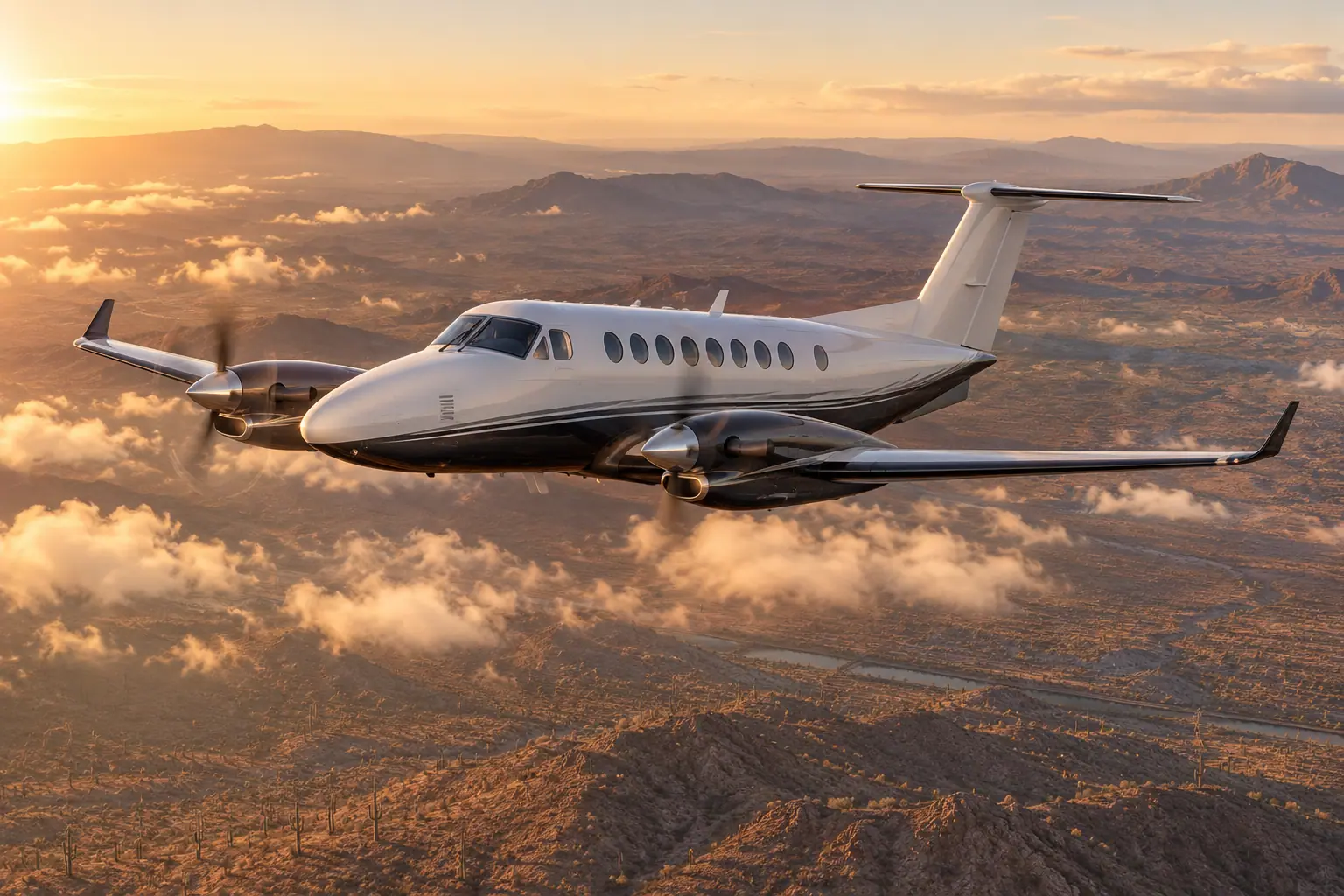
Turboprop
Turboprops run $2,200 to $3,500 per hour and cruise near 300 knots, which suits short regional hops and smaller fields. The King Air 350i and PC-12 NGX both reach 1,800 nautical miles, so Phoenix to Cabo or a Colorado ski town is realistic. Cabin height around 4 feet 10 inches rewards passengers who value efficiency over stand-up room.
Pilatus PC-12 NGX
- 6 seats
- 290 kt cruise
- 1,800 nm range
The PC-12 NGX seats six at 290 knots with 1,800 nautical miles of range, and its 40 cubic feet of baggage suits light packing. Single-engine efficiency and short-field capability make Glendale or Deer Valley practical. It is the value choice for Phoenix to Las Vegas or San Diego when the schedule matters more than cabin height.
Daher TBM 960
- 6 seats
- 330 kt cruise
- 1,730 nm range
Light jet
Light jets at $3,800 to $5,800 per hour cover 1,400 nautical miles and carry four to seven passengers. The HondaJet Elite II and Citation CJ4 Gen2 handle Los Angeles, Las Vegas, San Diego and Denver without a fuel stop. Runway needs are modest, so Scottsdale and Deer Valley remain viable when summer density altitude is managed.
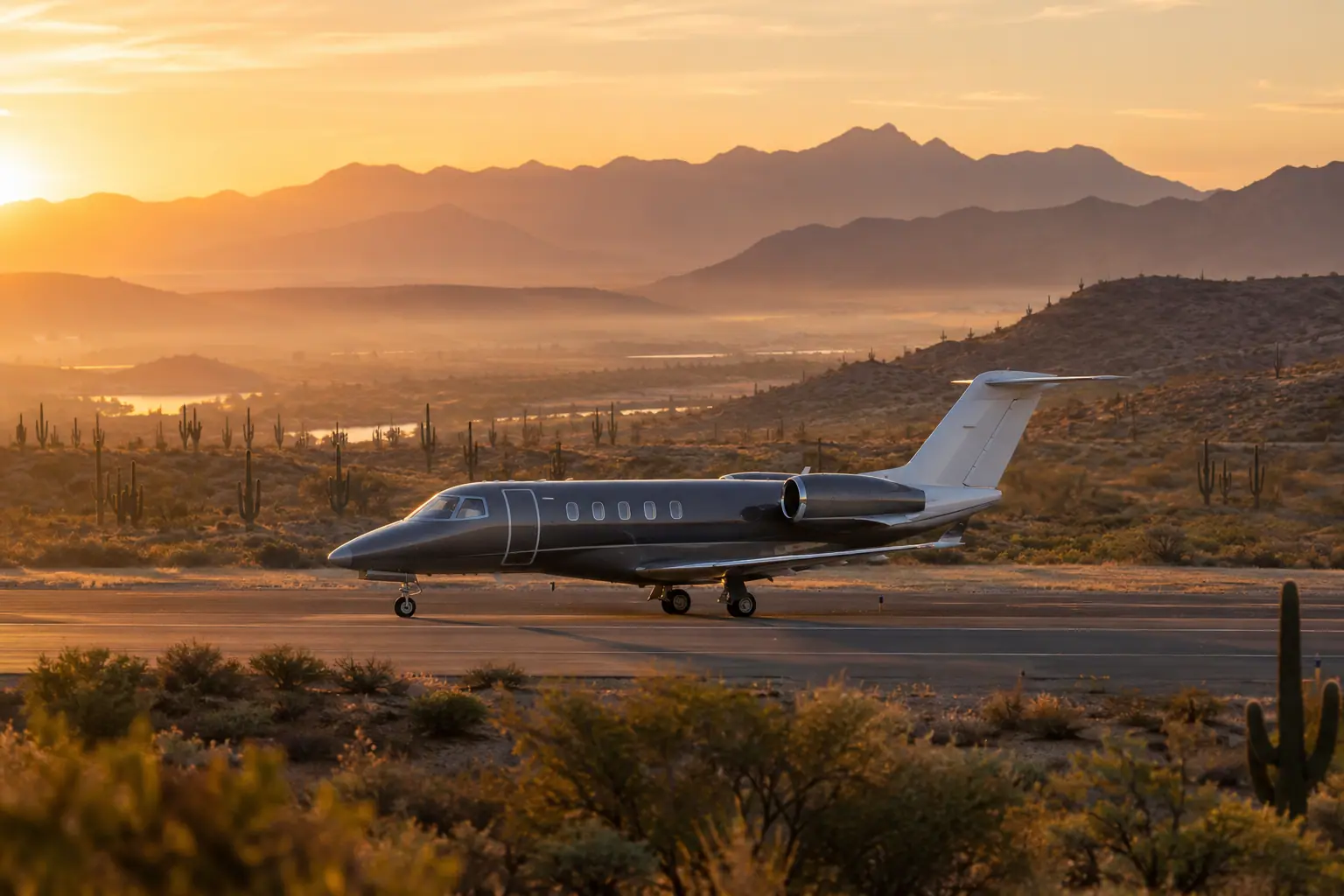
HondaJet Elite II
- 5 seats
- 422 kt cruise
- 1,550 nm range
The HondaJet Elite II seats five at 422 knots with 1,550 nautical miles of range and 66 cubic feet of baggage. It handles Los Angeles, San Diego and Denver from Phoenix without strain. The over-the-wing engine mount keeps the cabin quiet, which matters on a one-hour leg where conversation is the point.
Cessna Citation CJ4 Gen2
- 7 seats
- 451 kt cruise
- 2,165 nm range
The Citation CJ4 Gen2 carries seven at 451 knots and reaches 2,165 nautical miles with 71 cubic feet of baggage. That range covers Chicago and Dallas nonstop from Phoenix. Textron's light jet line has a reputation for straightforward handling at the smaller Valley fields, which keeps your departure options open.
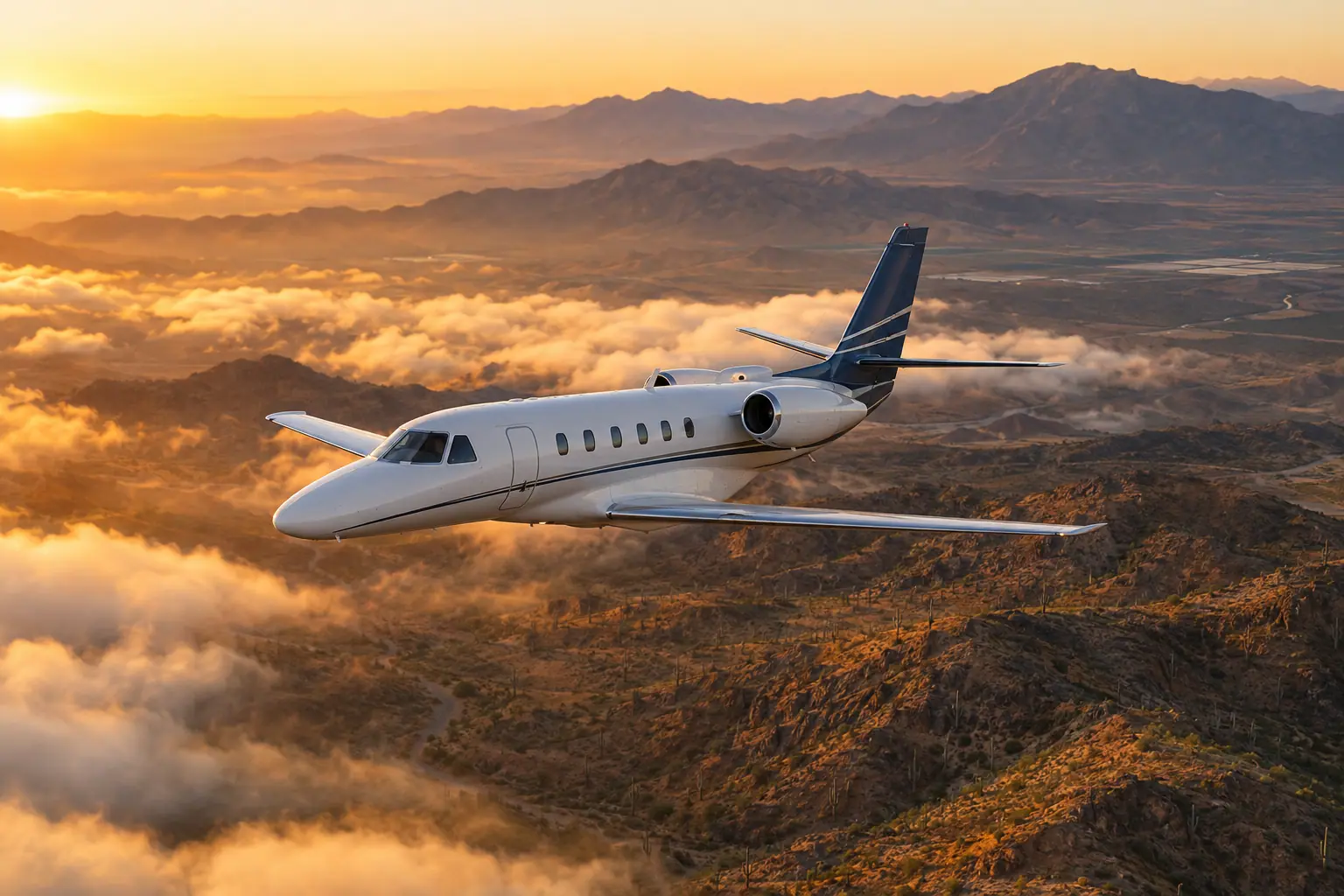
Midsize jet
Midsize jets run $5,200 to $7,800 per hour with 2,100 nautical miles of range and cabins you can stand up in. The Hawker 800XP and Citation XLS+ seat eight and reach Chicago, Dallas and Houston comfortably. Cabin height near 5 feet 9 inches makes a four-hour leg feel like a normal workday rather than a squeeze.
Cessna Citation XLS+
- 8 seats
- 441 kt cruise
- 2,100 nm range
The Citation XLS+ carries eight at 441 knots with 2,100 nautical miles of range and 90 cubic feet of baggage. That baggage volume is unusually generous for a midsize and handles golf clubs or trade-show materials. Phoenix to Dallas or Houston nonstop is routine, and the cabin height makes the leg civil.
Cessna Citation Latitude
- 9 seats
- 446 kt cruise
- 2,700 nm range
Super-midsize jet
Super-midsize aircraft at $7,200 to $10,000 per hour stretch range to 3,200 nautical miles and seat eight to ten. The Gulfstream G280 and Citation X+ make New York, Miami and Washington, DC nonstop from Phoenix. Baggage capacity of 154 cubic feet on the G280 handles ski gear or a full road-show load.
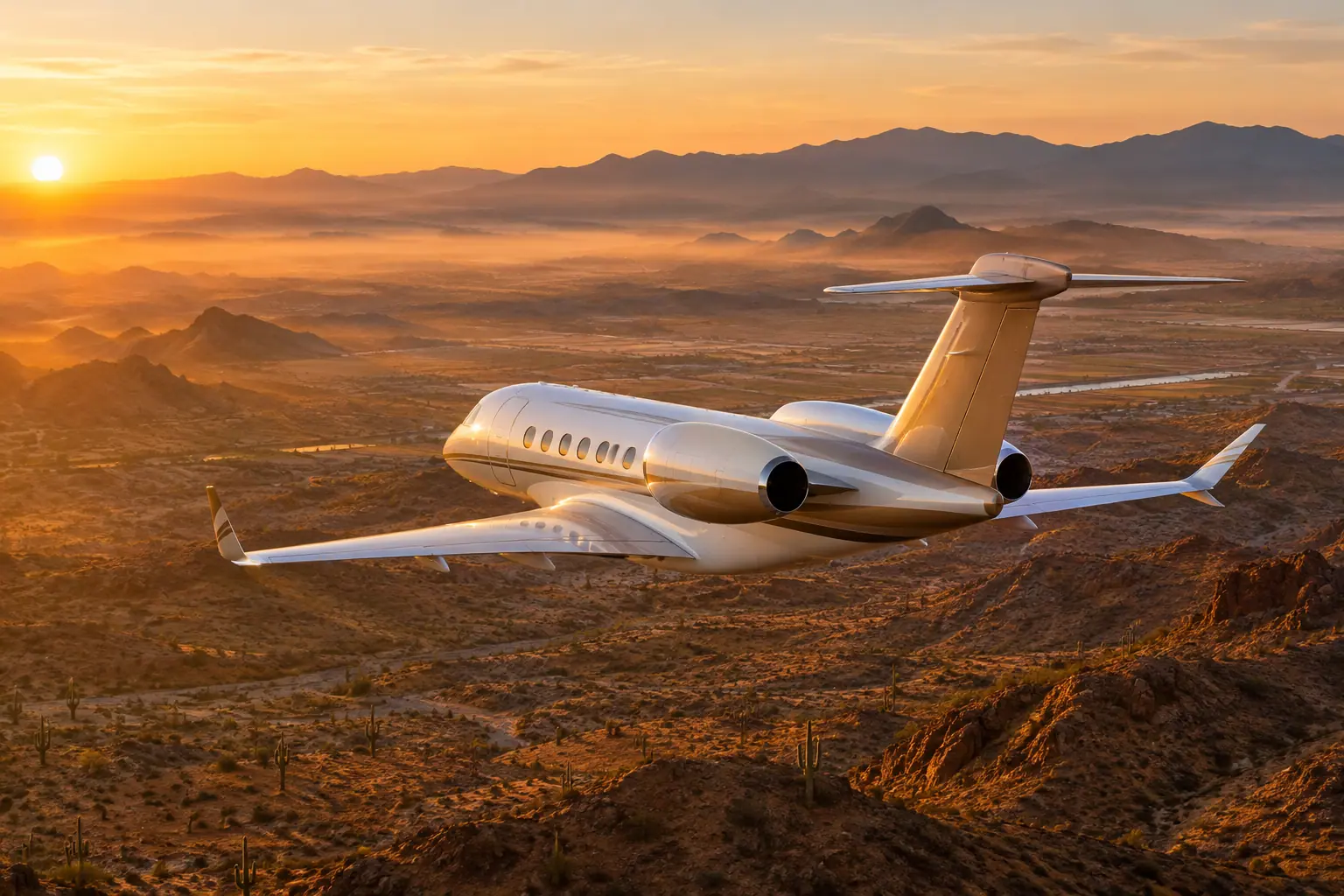
Cessna Citation X+
- 9 seats
- 527 kt cruise
- 3,460 nm range
The Citation X+ carries nine at 527 knots with 3,460 nautical miles of range and 82 cubic feet of baggage. It is the fastest aircraft in this fleet, which shortens transcontinental legs. Phoenix to Washington, DC or Boston becomes a single flight rather than a connection, and the cabin is 5 feet 8 inches tall.
Bombardier Challenger 350
- 10 seats
- 470 kt cruise
- 3,200 nm range
Heavy jet
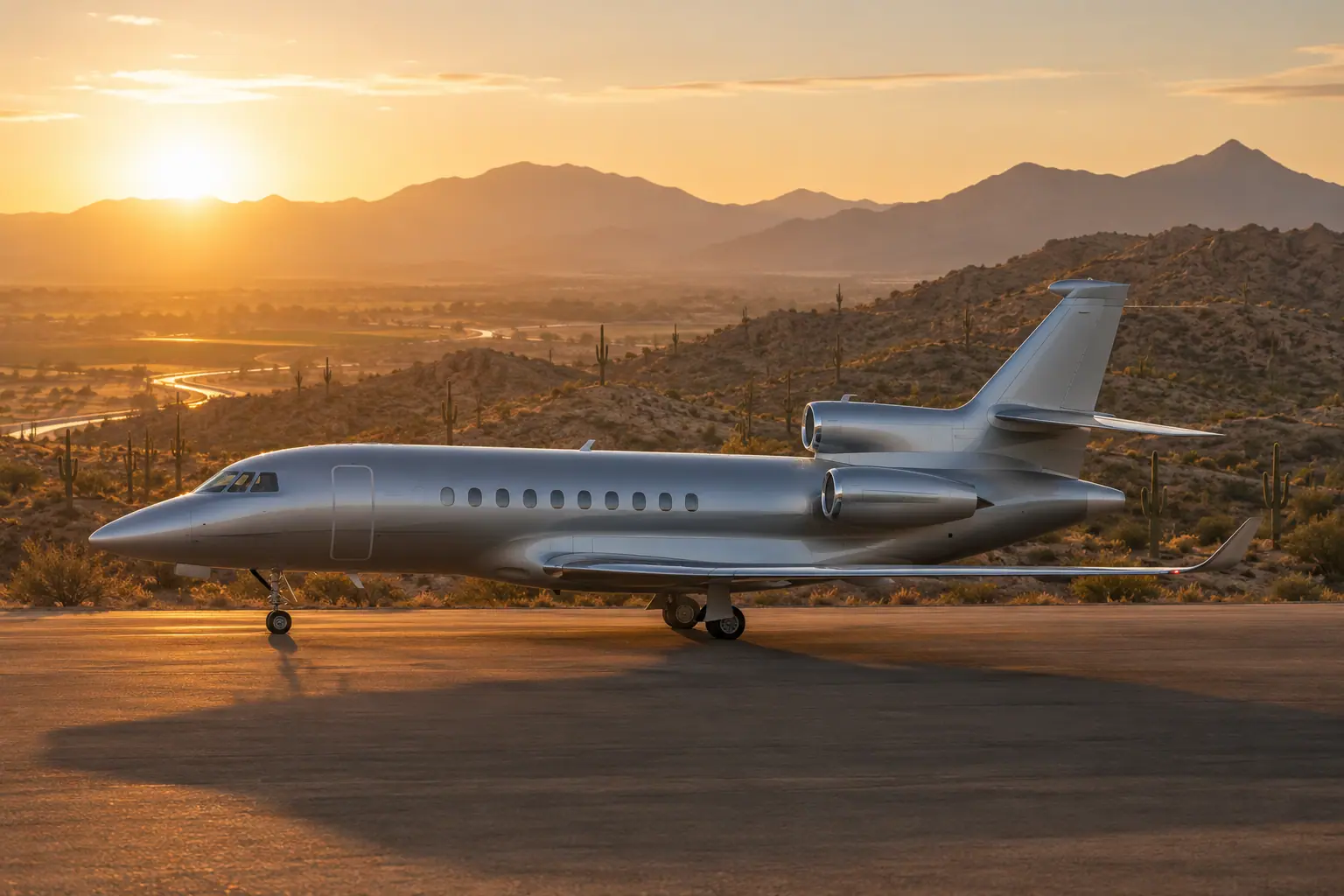
Heavy jets run $9,500 to $14,500 per hour with 4,000 nautical miles of range and cabins for ten to fourteen. The Challenger 650 and Falcon 900LX fly Phoenix to Nassau or Turks and Caicos without a stop. Stand-up cabins over 6 feet tall and 115 cubic feet of baggage make long international legs practical.
Dassault Falcon 900LX
- 12 seats
- 459 kt cruise
- 4,750 nm range
The Falcon 900LX carries twelve at 459 knots with 4,750 nautical miles of range, the longest in this fleet. Three engines and a 33-foot-2 cabin suit long international legs where redundancy and space both matter. Phoenix to Europe becomes a realistic single flight with a CBP stop arranged on the return.
Gulfstream G450
- 14 seats
- 476 kt cruise
- 4,350 nm range
Choosing Phoenix aircraft options
If your trip is under two hours, then a turboprop or light jet usually beats a larger aircraft on total cost and field access. Phoenix to Las Vegas is 222 nautical miles in 51 minutes by light jet, and Phoenix to Los Angeles is 327 nautical miles in 1 hour 6 minutes. Those legs rarely justify a midsize cabin, though the stand-up room is real on a longer day.
When the passenger list reaches eight with luggage, then midsize and super-midsize aircraft make the difference on a four-hour leg. Phoenix to Chicago is 1,252 nautical miles and 4 hours 6 minutes by light jet, which is tight for a light cabin but comfortable in a midsize. For New York at 1,854 nautical miles and 5 hours 35 minutes, super-midsize is the honest answer. All flights are arranged with FAA Part 135 operators who hold operational control, and this brokerage acts as your agent under DOT Part 295.
Questions
What private jet aircraft Phoenix travelers book most often?
Light and midsize jets cover most private jet aircraft Phoenix demand, with light jets at $3,800 to $5,800 per hour and 1,400 nautical miles of range. The Citation CJ4 Gen2 and Hawker 800XP show up on many four-to-eight passenger legs. Turboprops handle shorter regional trips where field size matters more than cabin height. Final availability depends on the operator's schedule on your dates.
How much does a private jet charter from Phoenix cost?
Charter pricing runs from $2,200 per hour for a turboprop to $14,500 per hour for a heavy jet, and route totals vary with distance and aircraft. Phoenix to Los Angeles is estimated at $4,000 to $6,500 by light jet, while Phoenix to New York runs $21,000 to $32,500. These are estimates, not quotes; the operator's written quote is the binding number.
Which airports near Phoenix can private jets use?
**Four fields serve the Valley: Sky Harbor at 1,135 feet with an 11,489-foot runway, Scottsdale at 1,510 feet with 8,249 feet, Deer Valley at 1,478 feet with 8,196 feet, and Glendale Municipal at 1,071 feet with 7,150 feet.** Sky Harbor and Scottsdale have established FBOs on the field. Each sits 242 to 258 miles from the city strip. Your planner matches the field to your aircraft and destination.
Does summer heat affect private jet aircraft Phoenix departures?
Yes: July density altitude reaches 4,500 feet at Sky Harbor and 5,000 feet at Scottsdale, and peak summer afternoons push those figures to 5,100 and 5,500 feet. Thin air lengthens takeoff rolls and can trim payload or fuel. When your departure falls in a July afternoon window, the operator may shift the time or reduce the load. Planning ahead avoids a last-minute surprise.
Can I fly nonstop from Phoenix to the East Coast or Caribbean?
Super-midsize and heavy jets make those routes nonstop: the Gulfstream G280 reaches 3,600 nautical miles and the Falcon 900LX 4,750 nautical miles. Phoenix to Nassau is 1,869 nautical miles and 5 hours 37 minutes by light jet, which needs a fuel stop in a light cabin. International legs require CBP clearance on return, and your planner arranges the customs stop in advance.
How do I confirm the aircraft and operator before booking?
Your quote names the specific aircraft and the FAA Part 135 operator that will fly it, and you review both before signing. The operator holds operational control and provides the flight crew, maintenance and insurance. This brokerage acts as your agent under DOT Part 295 and does not own aircraft. Ask for the operator's certificate number and the tail number; a legitimate charter arranges both without hesitation.
What does baggage capacity look like across the fleet?
Baggage ranges from 40 cubic feet on the PC-12 NGX to 154 cubic feet on the Gulfstream G280, which matters on longer trips. The Citation XLS+ offers 90 cubic feet, generous for a midsize, while the HondaJet Elite II gives 66. If your group travels with golf clubs or ski gear, tell your planner at the quote stage so the aircraft matches the load.
Is a turboprop or light jet better for short Phoenix legs?
For legs under 300 nautical miles, a turboprop at $2,200 to $3,500 per hour often costs less than a light jet at $3,800 to $5,800 per hour. Phoenix to Las Vegas is 222 nautical miles in 51 minutes, and Phoenix to San Diego is 265 nautical miles in 57 minutes. Field access at Glendale and Deer Valley can also favor the turboprop.